
Enzalutamide (Xtandi): Who It's For, When It's Started, and Why It Helps

The PSA number can feel like a smoke alarm. After surgery or radiation, it drops, everyone breathes again, then months or years later it starts to climb. Sometimes it rises even while testosterone stays very low from hormone shots. That's the moment many families hear a new word: enzalutamide (Xtandi).
Xtandi is a once-daily pill that blocks androgen signals that prostate cancer cells often use as fuel. It doesn't replace every other treatment, and it isn't for every situation. Still, it has become a mainstay for several advanced and returning prostate cancer settings.
This guide explains who Xtandi is for, when clinicians add it, and why it can slow the disease. It also covers practical safety checks and what to expect with a prescription.
This is general education, not personal medical advice. Treatment choices depend on your stage, prior therapies, and health history, so make decisions with your oncology team.
What enzalutamide (Xtandi) does inside the body
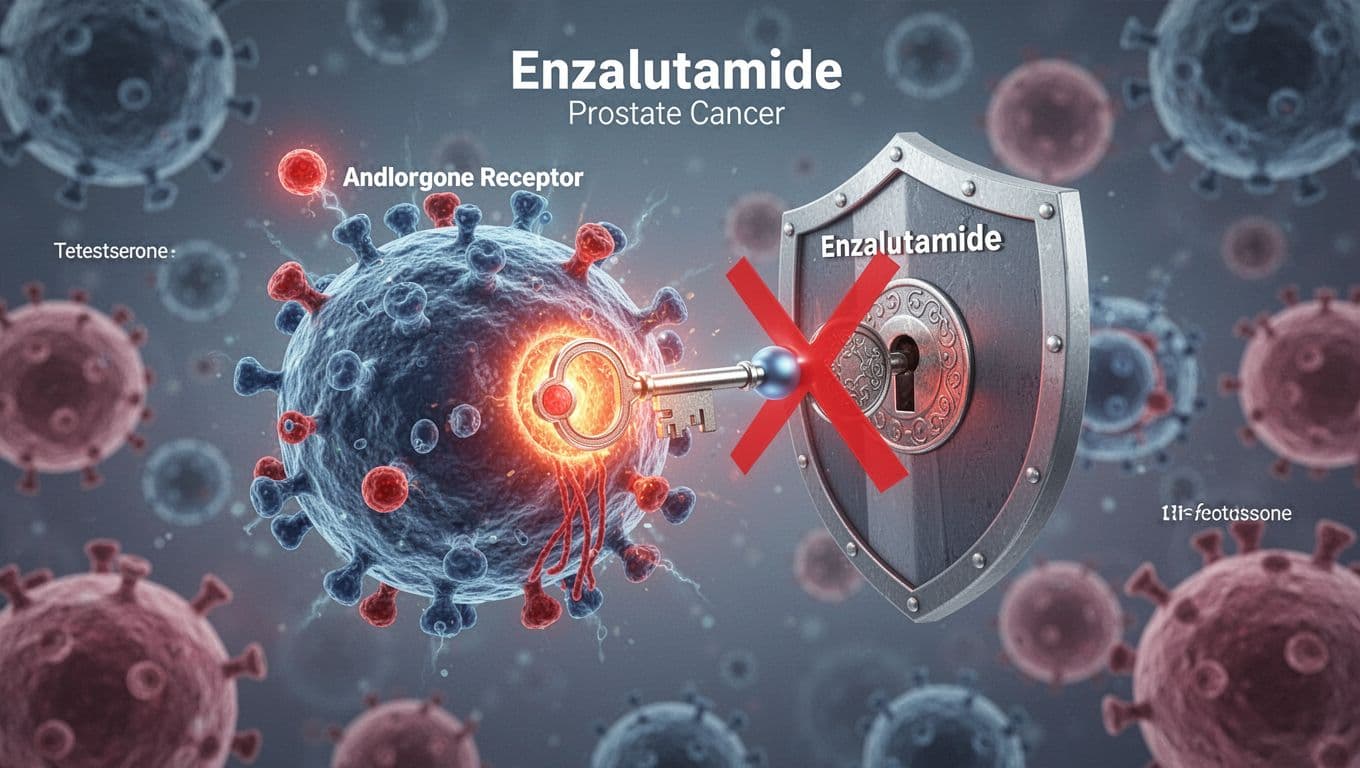 An androgen receptor "lock and key" view of how enzalutamide can block growth signals in prostate cancer cells, created with AI.
Xtandi is an androgen receptor pathway inhibitor (often shortened to ARPI). In plain terms, it blocks the "receiver" that picks up hormone signals. Prostate cancer often grows in response to androgens (like testosterone). Even when the body's testosterone level is pushed down with androgen deprivation therapy (ADT), cancer cells can keep finding ways to respond to tiny hormone signals.
That's why Xtandi is frequently used with ongoing ADT (such as GnRH injections) or after surgical removal of the testicles (orchiectomy). ADT lowers the amount of androgen in circulation, while Xtandi blocks the cell's ability to act on the message. Think of it as turning down the volume and also unplugging the speaker.
For the most current dosing and safety details, clinicians and pharmacists rely on the official prescribing information, such as the FDA Xtandi label (January 2025).
Why blocking the androgen receptor still helps, even when testosterone is already low
Doctors often talk about "castration-level" testosterone, meaning testosterone has been lowered to very low levels with ADT. Many people assume that should end the story. Yet prostate cancer can be stubborn. Cells can increase the number of androgen receptors, change how those receptors behave, or make use of very small hormone amounts.
A simple analogy helps. Imagine testosterone as a key and the androgen receptor as a lock. ADT reduces how many keys are floating around. Xtandi works closer to the lock. It helps prevent the key from turning the lock and sending a "grow" signal.
Because it targets the receptor, Xtandi can still matter even when lab values show testosterone is already suppressed. That's also why PSA can fall after adding an ARPI, even if ADT has been on board for a long time.
How Xtandi is taken and what people usually notice first
Most patients take Xtandi at home. The standard dose is 160 mg by mouth once daily, and it can be taken with or without food. Many people choose a consistent time of day, like brushing teeth before bed, because routines reduce missed doses.
Early on, some changes are subtle. Fatigue can sneak in, like a heavier backpack on a normal day. Hot flashes can continue because ADT still plays a role. Blood pressure may rise, so home readings can be useful. Muscle and joint aches may show up, too.
Side effects vary widely. One person keeps hiking, another needs more rest, and both experiences can be real. The goal is to catch problems early, adjust when needed, and keep daily life steady.
Who Xtandi is for, matching the drug to the prostate cancer stage
Xtandi is FDA-approved for adult men in several prostate cancer settings. The "right fit" depends on two key questions: Has the cancer spread on scans (metastatic vs nonmetastatic), and is it still responding to hormone lowering (castration-sensitive vs castration-resistant)?
Here's a quick, patient-friendly map of the four approved uses:
| FDA-approved setting | What it means in everyday terms | Common "why now" reason |
|---|---|---|
| Metastatic castration-resistant (mCRPC) | Cancer has spread, and it's growing even with ADT | PSA rises, scans worsen, or symptoms appear despite low testosterone |
| Nonmetastatic castration-resistant (nmCRPC) | No spread seen on scans yet, but cancer is acting active on ADT | PSA climbs fast while testosterone stays low |
| Metastatic castration-sensitive (mCSPC) | Cancer has spread, but still responds to hormone lowering | Start stronger therapy earlier to slow progression |
| Nonmetastatic castration-sensitive with high-risk biochemical recurrence (high-risk BCR) | PSA rises after local treatment, scans show no spread, higher risk of later metastasis | Slow or delay spread when PSA is rising quickly |
The FDA summarized the newer "high-risk biochemical recurrence" approval here: FDA approval for high-risk biochemical recurrence (Nov 2023).
Castration-resistant prostate cancer: when the cancer grows despite low testosterone
"Castration-resistant" doesn't mean hormone therapy failed completely. It means the cancer has learned to grow despite very low testosterone. In real life, that often looks like a PSA that keeps rising while on ADT. Sometimes imaging shows new or enlarging spots. Other times symptoms change first, such as new bone pain or more fatigue.
Xtandi is a core option for both:
- mCRPC (spread is visible)
- nmCRPC (no spread visible yet)
Prior treatments matter. Some men have already had chemo (like docetaxel). Others used a different ARPI earlier. Your oncologist weighs what has been tried, what worked, and what side effects you can tolerate.
Castration-sensitive prostate cancer: why some men start Xtandi earlier
"Castration-sensitive" means hormone lowering still works, at least for now. If the cancer is metastatic at diagnosis, many clinicians now intensify treatment early, instead of waiting for resistance to develop.
In the ARCHES trial, adding Xtandi to ADT reduced the risk of progression or death (hazard ratio 0.39). You don't have to be a statistician to feel the point: earlier, stronger control can buy time before complications show up.
If you want context on longer-term follow-up reporting, see coverage like ARCHES 5-year follow-up at ASCO 2025 (UroToday).
High-risk biochemical recurrence after surgery or radiation: the newer group that may qualify
Biochemical recurrence means PSA is rising after a treatment that aimed to cure, like prostatectomy or radiation. Scans may still look clean. That can feel confusing, like hearing footsteps but not seeing anyone.
In November 2023, the FDA approved Xtandi for nonmetastatic castration-sensitive prostate cancer with high-risk biochemical recurrence. "High-risk" is often tied to a PSA doubling time of 9 months or less, meaning PSA rises quickly. In the EMBARK trial, Xtandi-based therapy delayed metastasis for men in this situation.
Many men in this group have already had surgery or radiation. Some aren't good candidates for more local radiation. For them, the goal shifts to delaying spread and staying well for as long as possible.
For a deeper look at EMBARK results in a peer-reviewed format, see a post hoc EMBARK analysis in Nature.
When doctors choose Xtandi, and what they consider first
Prostate cancer care often follows a long timeline. First comes diagnosis, then local therapy for many patients, then years of PSA checks. If PSA rises, ADT may enter the picture. After that, treatment may escalate based on risk and evidence of progression.
Clinicians tend to start Xtandi in three broad moments:
- Progression on ADT (castration-resistant disease)
- Newly diagnosed metastatic castration-sensitive disease where intensification is recommended
- High-risk PSA-only relapse after surgery or radiation (high-risk biochemical recurrence)
Before prescribing, teams look beyond the cancer. They review blood pressure, fall risk, bone health, seizure history, and other medications. They also talk about daily life. Some patients want fewer clinic visits. Others prioritize keeping fatigue as low as possible because they're caretakers or still working.
Guideline updates can influence these choices. For perspective on how systemic therapy guidance continues to evolve, see reporting on ASCO's living guidelines for prostate cancer systemic therapy.
Typical decision points: PSA trends, scan results, and symptoms
On paper, the triggers can sound technical. In the clinic, they often show up as patterns.
A fast-rising PSA is one of the clearest signals, especially when testosterone stays suppressed on ADT. Imaging may reveal new lymph node spots or bone lesions. Symptoms can also push decisions forward, such as bone pain, weight loss, or worsening urinary problems.
For high-risk biochemical recurrence, PSA doubling time becomes a key clue. A PSA that doubles quickly can hint that the cancer is moving faster than the scans can show.
Still, no single number makes the decision alone. Good teams combine PSA trends, scan results, side effects from current therapy, and the patient's goals.
Sequencing and combinations: how Xtandi fits next to ADT, chemo, and similar drugs
Xtandi is often used with ADT, not instead of it. In metastatic castration-sensitive disease, it may start near the beginning, alongside ADT, to slow progression sooner. In castration-resistant settings, it's often an escalation step when ADT alone stops holding the line.
Sequencing matters because several drugs target the androgen pathway. Others include apalutamide and darolutamide. If a patient has already taken one ARPI, switching to another may not always give a strong response, since the cancer can develop cross-resistance. That's why oncologists plan the order carefully, sometimes mixing in chemo, radiation to bone lesions, or other targeted options depending on genetics and prior response.
The best plan is the one that fits your disease biology and your life.
Why Xtandi can be worth it, plus side effects and safety checks to know
It helps to name the trade-off clearly. Xtandi often offers more time before the cancer grows, and in some settings it helps delay spread. In exchange, it can bring side effects that affect energy, balance, and blood pressure. Most can be managed, but they shouldn't be ignored.
The upside: what "working" can look like in everyday life
When Xtandi works, it may look almost boring, in a good way. PSA drops or stabilizes. Scans stay steady. Bone pain improves or doesn't appear. Life continues with fewer interruptions.
It can also mean a longer stretch before needing the next treatment, such as chemotherapy. For many families, that time matters because it restores a sense of control. Plans get made again. Travel becomes possible. Grandkids get picked up from school.
Response varies, and monitoring continues. PSA checks, blood pressure checks, and periodic imaging help the team confirm that the plan still makes sense.
Common side effects, red flags, and simple ways to lower risk at home
Common side effects reported for enzalutamide include fatigue, hot flashes, muscle or joint pain, constipation or diarrhea, headache, high blood pressure, and decreased appetite. Falls and fractures can also occur, especially in older adults or those with weaker bones.
A calm home plan can reduce surprises:
- Track blood pressure a few times a week at first, then as advised.
- Move slowly from sitting to standing, especially at night.
- Review all medications with your pharmacist, since drug interactions can matter.
- Ask about bone protection, such as calcium, vitamin D, and other bone-strength steps if appropriate.
- Tell the care team about new confusion, severe headache, or major balance changes.
Get urgent medical help for seizure-like activity, sudden severe headache with confusion or vision changes (possible PRES), chest pain, or signs of a serious allergic reaction.
Access and affordability: prescriptions, prior authorization, and how a pharmacy can help
Xtandi is prescription-only, and insurance often requires prior authorization. That usually means the plan wants proof of diagnosis and stage, confirmation that ADT is ongoing when required, and dosing that matches labeling (commonly 160 mg per day). Approvals may be time-limited and need renewal paperwork later.
This is where a full-service pharmacy can take work off your plate. A pharmacy team can coordinate with the prescriber, track prior authorization status, and confirm refill timing. Home delivery also helps, since missed doses can happen when a bottle runs out during a busy week.
With Chemistway's model, patients can also use pharmacist check-ins, refill reminders, and prescription transfers to keep therapy consistent, especially when oncology visits are spaced out.
Conclusion: Who, when, and why, in one quick recap
Xtandi often enters the story when PSA keeps rising or when doctors want stronger control earlier. In simple terms, it blocks androgen receptor signaling so cancer cells can't "hear" growth messages as easily.
Here's the checklist-style recap:
- Who may qualify: mCRPC, nmCRPC, mCSPC, or nonmetastatic castration-sensitive disease with high-risk biochemical recurrence
- When it's started: after progression on ADT, at the start of metastatic hormone-sensitive treatment, or during high-risk PSA-only relapse after local therapy
- Why it's used: to slow growth, delay spread in some settings, and extend time before the next therapy
Bring your next appointment three topics: your goals, likely side effects, and insurance steps. A conversation with your oncologist and pharmacist can turn Xtandi from a scary new word into a clear plan.