
From Washington to the Middle East: How US Tariffs and Regional Wars Together Threaten Global Medicine Affordability

Refilling a prescription shouldn't feel like waiting on a storm to pass. Yet in March 2026, two forces can collide in ways that patients actually notice. One starts in Washington, where tariff rules and trade reviews can change quickly. The other starts thousands of miles away, where conflict in the Middle East is disrupting major shipping lanes.
Even when pharmaceutical tariffs are low, wars can still raise real costs. Fuel surcharges climb, insurance premiums jump, ships take long detours, and delivery windows stretch. Those pressures don't stay "in the supply chain." They show up as backorders, rushed substitutions, higher copays, and fewer discounts for cash-pay patients.
 Photo by Etatics Inc.
How US tariffs and trade deals can quietly shape what you pay at the pharmacy
A tariff is a tax on imported goods. In plain terms, it can make products cost more before they ever reach a pharmacy shelf. Medicines are complicated, though. Many "US medicines" are built from ingredients shipped across borders, then processed, tested, packaged, and moved again.
That's why trade policy matters even when you don't see a tariff line on your receipt. A single tablet can depend on active pharmaceutical ingredients (APIs), specialized chemicals, packaging, and cold-chain logistics. Each link adds cost, and trade uncertainty can make companies pad budgets for risk.
In March 2026, the headline is that many pharmaceuticals are treated as essential and often receive exemptions or low rates. Still, policy can shift through new investigations or "national security" reviews. That can push manufacturers to change suppliers, redo paperwork, and renegotiate contracts, all of which costs money.
For a current example of how trade talks can affect generic supply without changing the medicine itself, see reporting on the US-India interim trade deal and tariff carveouts for pharma.
March 2026 snapshot: pharma is mostly exempt, but the policy risk isn't gone
Right now, there's no single, sweeping new US tariff hitting all medicines from India. A February 2026 court ruling also knocked out a previously discussed 25 percent tariff on Indian pharmaceuticals, based on the latest public reporting summarized in the March 2026 updates.
China remains a different case. Some pharmaceutical-related tariffs are still tied to earlier trade disputes, and new Section 301 activity has kept companies on alert. Even when finished drugs avoid heavy duties, related inputs (chemicals, intermediates, packaging) can still face trade friction.
At the same time, broader tariff plans have treated many chemical categories as "mostly spared," which matters because pharma manufacturing depends on chemical supply. Here's helpful context from Chemical and Engineering News on chemicals and the 2026 tariff plan.
Why "no tariff" doesn't always mean "no price increase"
Think of medicine pricing like a supermarket in a hurricane warning. The store can keep prices "the same," but it may still limit promos, reduce selection, or reorder less. In drug supply chains, fear of future restrictions can trigger similar behavior.
Even with low tariffs, trade policy can create hidden costs:
- Supplier switching: New API sources require qualification work, testing, and documentation.
- Contract resets: Manufacturers re-price long-term agreements to cover uncertainty.
- Compliance overhead: More checks and proof can slow releases and raise admin costs.
- Stockpiling: Carrying extra inventory ties up cash, so financing costs rise.
- Cold-chain planning: Sensitive products often need tighter timelines, which get pricier when shipping becomes less predictable.
If you use an online pharmacy, these issues can show up as longer "processing" time before a shipment even leaves. If you're getting specialty meds, the impact can be sharper because fewer suppliers can step in fast.
How Middle East conflicts drive up medicine costs through shipping, fuel, and delays
Many people hear "Middle East conflict" and think "oil prices." That's part of the story, but shipping lanes are just as important for medicine affordability.
In March 2026, attacks in and around the Red Sea have pushed major carriers to avoid the route. Tensions have also affected Persian Gulf logistics, with heightened risk near the Strait of Hormuz. When ships reroute, they burn more fuel, spend more days at sea, and arrive out of schedule. Insurers respond by raising premiums, while carriers add surcharges.
The result is simple: the same box of medicine costs more to move, and it takes longer to arrive. That can squeeze wholesalers and pharmacies that operate on tight inventory, especially for fast-moving generics and time-sensitive treatments.
For ongoing shipping updates tied to the Red Sea crisis, this report on renewed Red Sea shipping threats and carrier responses provides a useful snapshot of how quickly routes can change.
What happens when ships avoid the Red Sea and the Persian Gulf
When carriers avoid the Red Sea and Bab el-Mandeb, many routes swing around Africa's Cape of Good Hope. That detour can add roughly 10 to 14 days on certain lanes, based on March 2026 shipping advisories summarized in the current reporting.
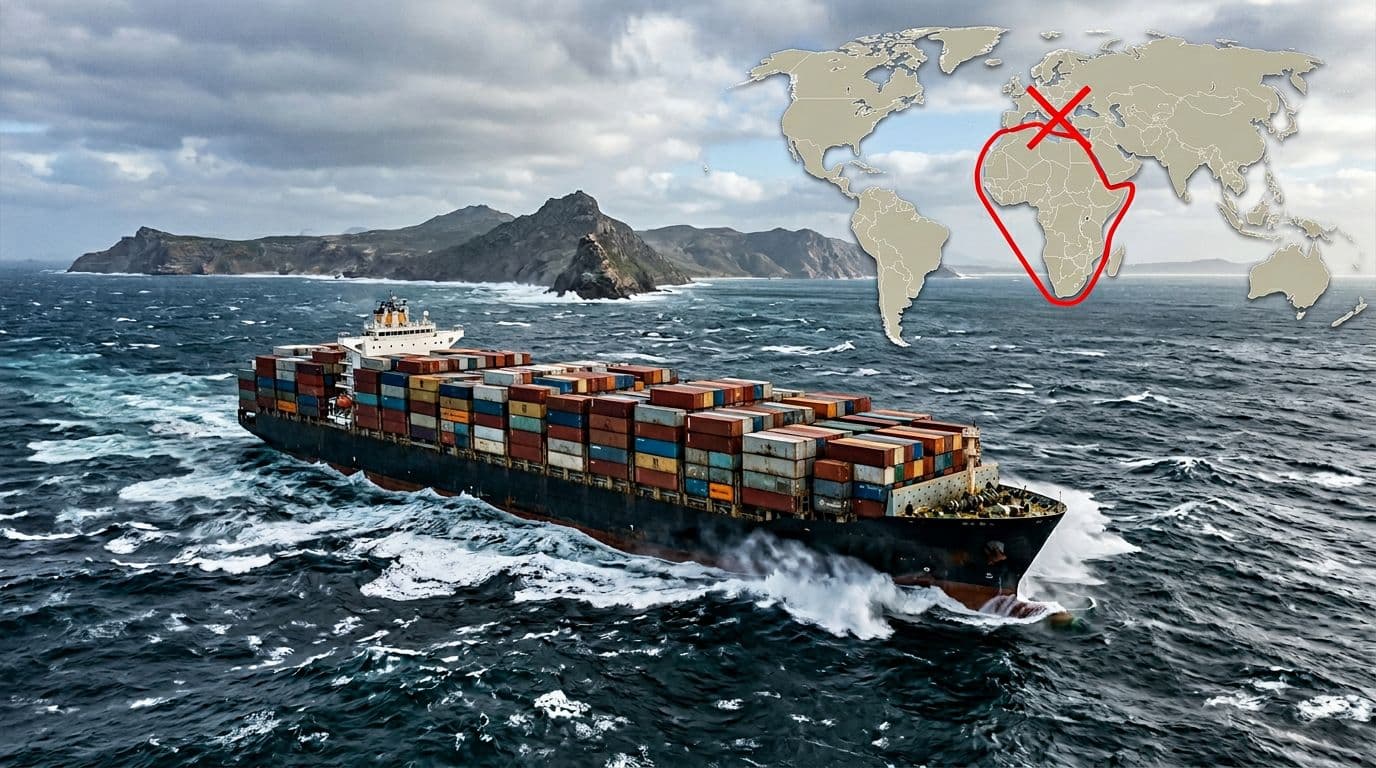 Ships rerouting around Africa can add days to delivery schedules, especially when carriers avoid high-risk zones (created with AI).
Longer trips create knock-on problems. Containers and refrigerated units end up in the wrong place. Ports get hit with bunching, where too many ships arrive late at once. Air freight can fill up fast when companies try to "rescue" urgent shipments.
This is where patients feel it. Pharmacies can't dispense what they don't have. Clinics may delay starts, stretch existing stock, or spend time calling around to locate supply.
One quick way to visualize the pressure is to match shipping disruptions to patient outcomes:
| Disruption | What changes for shippers | What patients may notice |
|---|---|---|
| Reroutes around Africa | Longer transit, higher fuel burn | Late refills, fewer in-stock options |
| Higher cargo insurance | Added per-shipment cost | Higher cash prices, fewer discounts |
| Reefer booking limits | Fewer cold-chain slots | Delays for injectables and biologics |
| Air cargo backlogs | Slower emergency replenishment | More backorders, rushed substitutions |
The takeaway: delays don't stay "over there." They land on the refill calendar.
Why oil price spikes hit drug prices even if the medicine isn't made in the Middle East
Oil touches nearly every step of pharma manufacturing and distribution. Ships run on fuel. Trucks run on diesel. Many packaging components and chemical inputs connect to petroleum markets. When crude rises quickly, carriers add fuel surcharges, and factories pay more to run equipment and source materials.
India is a major supplier of generic medicines and APIs for the US. India also relies heavily on imported oil, including oil flows tied to Middle East routes. When conflict threatens those flows, energy costs can rise and squeeze manufacturers' margins. Eventually, that cost pressure can translate into higher export prices or reduced discounting.
For March 2026 coverage tying conflict risk to energy and shipping disruption, Reuters has useful context on global energy costs rising as the Iran crisis disrupts shipping.
The real danger is the combo effect: trade uncertainty plus war disruption hits the same supply chain
On their own, low tariffs or a shipping detour can be manageable. The bigger threat is when both happen at once. Trade uncertainty can push companies to run leaner on certain items, while war disruption makes "just in time" deliveries less reliable. Together, they can turn small delays into long backorders.
Pharma supply chains also have single points of failure. A limited set of API plants may supply a large share of global volume. A narrow set of cold-chain lanes may handle sensitive injectables. When those chokepoints tighten, buyers compete for the same inventory, and prices can jump fast.
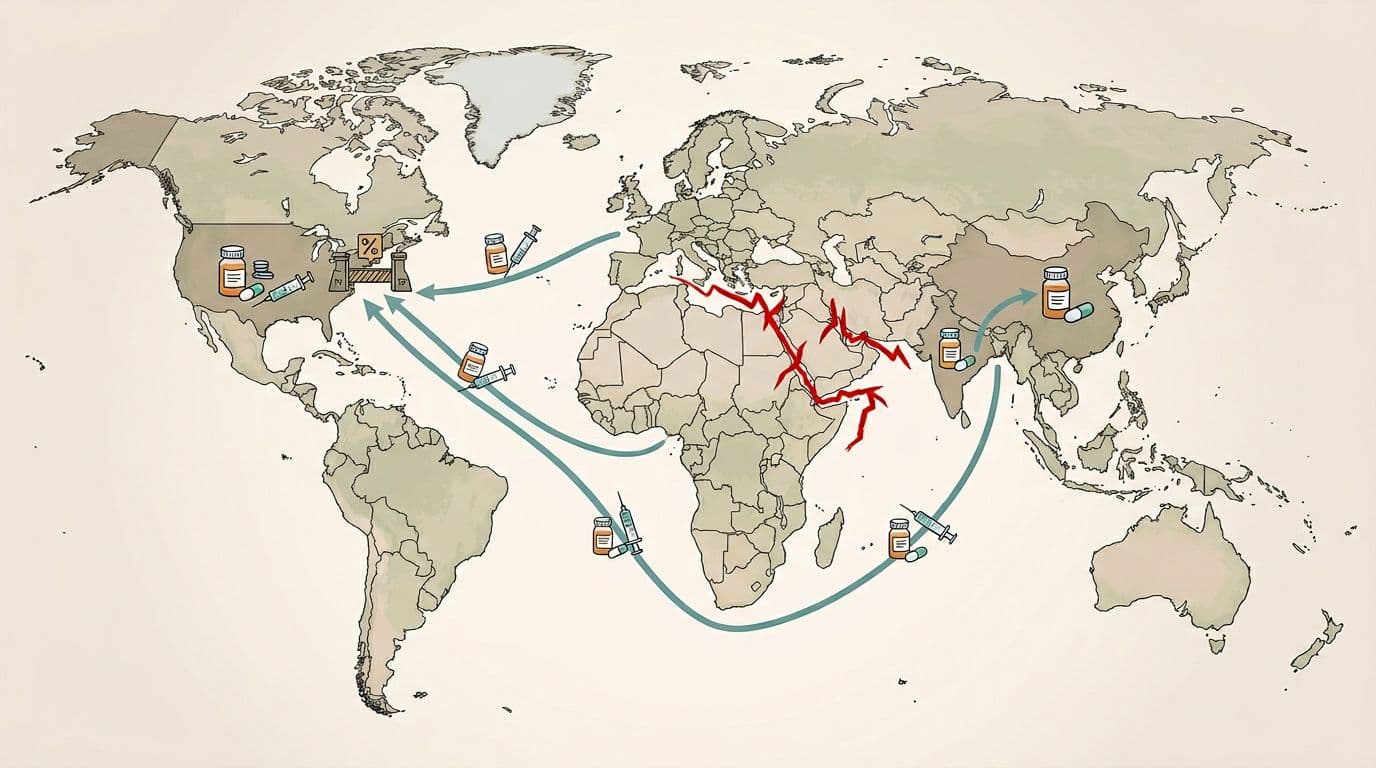 Medicine affordability can be squeezed by policy changes and route disruptions that affect the same global pathways (created with AI).
If you only watch tariffs, you can miss the bigger bill. Freight, insurance, and delays can raise costs even when tariff rates stay low.
For readers tracking policy shifts, a resource that follows active tariff proposals and changes is this 2026 tariff tracker. It helps explain why "nothing changed today" can become "everything changed next month."
From API shortages to backorders: how small disruptions turn into big shortages
A medicine shortage often starts quietly. An API shipment arrives late. A factory slows a batch. Packaging materials run short. Then wholesalers get partial fills, and pharmacies see "on backorder" flags.
Next, buyers may place larger orders than usual to protect themselves. That hoarding behavior drains the pipeline faster. After that, manufacturers may allocate supply, sending limited quantities to each buyer. Patients can then face rationing, delayed starts, or forced switches.
Prolonged disruption can also lead to canceled orders when shipping schedules become unreliable. That effect often hits lower-income regions first, then ripples outward. The US isn't immune, especially for drugs with few manufacturers or specialized handling needs.
Who gets hit first: patients on specialty meds, cold-chain drugs, and long-term refills
Some patients can swap brands with little risk. Others can't.
The groups most exposed tend to include people who rely on consistency:
- Oncology patients: Treatment cycles are timed, and delays can matter.
- Cold-chain medicines: Many injectables and biologics need stable temperature control.
- Transplant patients: Drug level stability can be critical, and substitutions require care.
- Diabetes patients using insulin: Timing and storage requirements add pressure.
- Heart and blood pressure patients: Missed doses can trigger fast setbacks.
If you or a loved one uses cancer medicines, it helps to know your refill timeline and options. Some people also compare availability across equivalent therapies with their care team. For example, Waldrugmart lists specialty products like Temozolomide 140mg capsules (generic Temodar) and other oncology treatments, which highlights how planning matters when therapies run on strict cycles.
Practical steps patients can take now to protect their refills and reduce surprise costs
Patients can't reopen a shipping lane or rewrite trade policy. Still, you can reduce risk with simple habits, especially during periods of disruption. The goal is not panic buying. The goal is avoiding last-minute scrambles.
Start by understanding how your pharmacy verifies and fills prescriptions, then match your ordering schedule to real transit times. International shipments can take longer when routes reroute or air cargo tightens. In those windows, ordering "when you have one week left" can be too late.
If you're using an online pharmacy for cost savings, make sure you know the documentation steps and expected delivery window. Waldrugmart's Get Started page outlines common submission options and the pharmacist check process, which can help you plan lead time before a refill becomes urgent.
 A small refill buffer can turn a shipping delay into an inconvenience instead of an emergency (created with AI).
Build a refill safety plan you can follow in 15 minutes
A refill plan works best when it's boring and repeatable. Keep it simple:
- Track days on hand for each long-term medicine.
- Set two reminders, one at 21 days, one at 14 days.
- Ask if 90-day fills are allowed for your medication and plan.
- Keep a current medication list (name, dose, prescriber, pharmacy).
- Confirm your shipping and tracking expectations when you order.
- Store temperature-sensitive meds the right way once they arrive.
If you're paying cash, it also helps to build a routine for price checks. Waldrugmart's guide on how to save on prescriptions without insurance can be a useful refresher on budgeting tactics when costs rise due to factors outside your control.
Ask these questions before you switch brands, change dose, or chase the lowest price
When supply tightens, people often try to solve it alone. That's risky with prescription drugs, especially for narrow-therapeutic-index medicines. Before you switch anything, bring your prescriber and pharmacist into the decision.
Use questions that lead to safe answers:
Is a generic equivalent appropriate for your condition? Will your insurance cover the alternative, and what will the copay be? Is the product available from more than one supplier? Does it need refrigeration or special handling? If it arrives late, what's the safe plan?
The cheapest option isn't always the lowest-risk option, especially when shipping times are unstable.
A short call can prevent a costly mistake, like ordering a product that requires cold-chain handling during a period of reefer constraints.
Conclusion
In March 2026, US tariffs on pharmaceuticals are often low or exempt, but patients can still face higher costs when war disrupts shipping. Detours, insurance surcharges, and fuel spikes can raise prices and delay deliveries even without new tariff bills. The best protection is a simple refill buffer and clear communication with your pharmacist and prescriber.
Watch for three signals: route disruptions in the Red Sea and Persian Gulf, sudden oil price jumps, and new trade reviews that change sourcing behavior. Then set your reminders, order earlier than usual, and keep a backup plan for substitutions.